Romanski Records Private records consulting
Boston · Est. 2026 Get in touch

A consulting practice by Simon RomanskiBy appointment

I turn decades of personal records into something you can search, understand, and use — at your kitchen table, on your own computer.

For people in disputes with a financial advisor, broker, or institution — and for anyone with thirteen years of statements, estate papers, and tax returns piled in a filing cabinet they’ve been avoiding. I come to your home or office, work on your machine, and leave you with a system you keep using after I’m gone. Your data never leaves your computer.

Begin with a free thirty-minute conversation No form to fill out. No calendar tool. Just an email.

A wooden kitchen table seen from above, scattered with paper financial statements, open ledger books, a fountain pen, a coffee cup, a manila folder, and a laptop turned at an angle.
Plate I. The work happens at your table, on your machine, with your records.

For thirteen years we trusted the same advisor. Then we started asking questions.

For more than thirteen years my family worked with the same registered investment advisor. We trusted them. We did not look closely at the statements. We did not ask many questions.

In early 2026 we started asking. The answers were vague, then evasive, then defensive. So I sat down at my own computer and built a system to organize everything we had. More than six thousand documents. Hundreds of PDFs of fund disclosures. A database of every brokerage statement going back to 2012. A search tool I could ask questions of in plain English.

What came out was not subtle. Hundreds of thousands of dollars sitting in cash for years while we paid advisory fees on it. A real estate fund the advisor recommended to us while holding equity in it himself, never disclosed in the firm’s public regulatory filings. A fee-sharing arrangement on private investments that contradicted the explicit terms of the advisory agreement we had signed. Suitability gaps in our retirement accounts. A college savings plan placed in a commissioned share class when an identical no-load version was available the entire time.

In April 2026 I sent the firm a written claim for $417,872. The case is ongoing.

Along the way, every person I talked to about it had their own version of the problem. Not always a dispute. Sometimes just a filing cabinet they had been avoiding for a decade. Sometimes a parent’s estate they had no map for. Sometimes accounts they had stopped looking at because they could not make sense of what they were seeing.

I realized this is a skill other people need.

Case the first

You are in a dispute with a financial advisor, broker, or institution.

Something is wrong. You have asked questions and not gotten real answers. You have years of statements and emails but no way to make sense of them. You do not have $300/hr for a lawyer to organize them for you. You need someone to help you build the evidence so you can have a real conversation. Or, if it comes to it, a real complaint.

Case the second

You have decades of records and no system.

Statements from accounts you have half-forgotten. Estate documents in three different filing cabinets. Tax returns going back twenty years. Medical records. Insurance policies. You would like to make sense of it all before you have to, or before you can’t. You would like your family to be able to make sense of it after you are gone.

Three engagements. Pick the one that fits.

i

Build a searchable archive of your records.

Bring everything to one place on your own computer. Statements, emails, PDFs, contracts, tax returns, anything you have. By the end you have a tool that lets you ask questions of your records in plain English. “What did I pay Vanguard last year.” “When did I sign the will.” “Show me every email about the mortgage refinance.” The answer comes back with the source document attached, every time.

ii

Analyze your financial accounts.

If you have had brokerage, retirement, or investment accounts for years, there is more in the history than the firm wants you to look at. I reconstruct your account history from the raw statements, calculate the fees you actually paid versus the fees you were told you were paying, find positions held too long, identify conflicts of interest in the funds you were placed in, and produce a written analysis you can use in any conversation with the firm.

iii

Prepare a dispute case.

Every claim has to be backed by a document. I find them, organize them, and produce a written evidence file you can use in correspondence, in arbitration, in a regulatory complaint with FINRA or the SEC, or in a lawyer’s hands. The goal is for you to walk into any conversation knowing more about your own records than the people across the table.

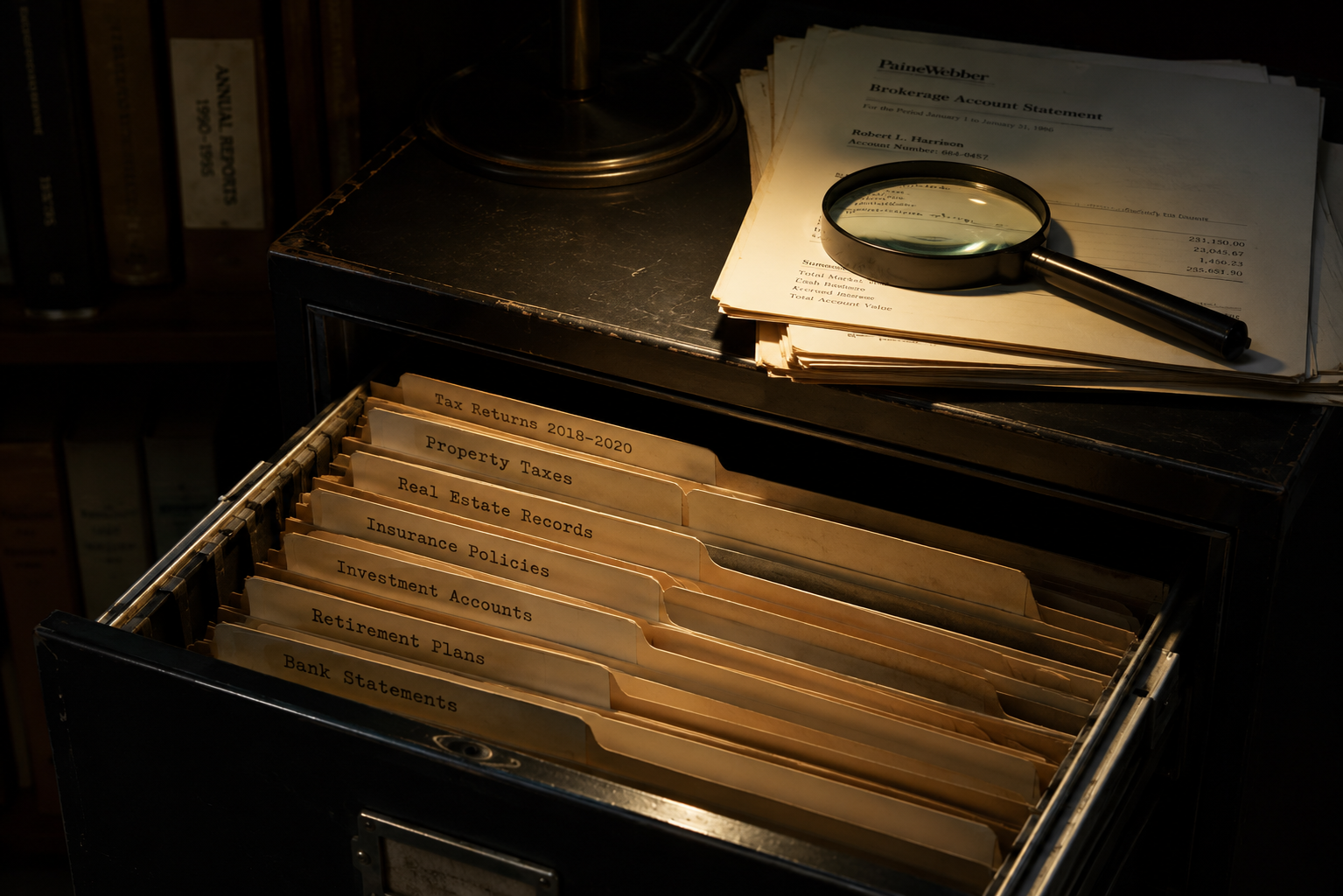
A close, dimly-lit still life of a half-open black metal filing cabinet drawer, manila folders fanned slightly, with a magnifying glass resting on a stack of brokerage statements and a small reading lamp casting warm light.
Plate II. Most of the answers are already in your files. They just have not been read in order.

A short, fixed-fee engagement. Then you have what you need.

  1. A free initial conversation, thirty minutes.

    You tell me what is going on. I tell you whether I can help, and how. If I cannot help, I will say so and point you to someone who can.

  2. A written scope and fixed-fee quote before we start.

    No hourly billing surprises. You sign off in writing before any work begins.

  3. The work itself, usually one to three days.

    In person at your home or office if you are local. Remote over screen-share if you are not. Either way I work on your computer. Your data does not leave it.

  4. A walk-through and training.

    I show you how everything works. You should be able to run searches, add new documents, and pull up old ones on your own.

  5. A written document explaining what we built.

    So if I am not around six months from now, you, your kids, or another consultant can pick up where we left off.

  6. Optional check-ins.

    Quarterly, yearly, or only when something changes. No subscription. No retainer. No automatic billing. You call me when you need me.

When the engagement ends, this is yours, for good.

A short list of promises, set in plain language.

A black-and-white documentary portrait of a man seated at a wooden desk, soft window light from the side, hands resting on an open manila folder.
Plate III. Simon Romanski, at the desk where this practice began.

I learned to do this work because I had to.

I am Simon Romanski. My background is in technology and problem-solving, not finance. I learned to do this work because I had to.

When my family realized in early 2026 that our investment advisor had not been straight with us for more than a decade, we did not have the option of hiring someone to sort it out for us. The records were too many, the firm too unhelpful, the legal fees too high. So I learned to use AI tools to do it myself. It took months. The result was a written claim for $417,872 against the firm, backed by every document and every calculation, and a system on my own computer that I will use for the rest of my life.

I am not a lawyer. I am not a CPA. I am not a licensed financial advisor. What I am is someone who can use AI to turn complicated personal records into something you can search, understand, and use. And someone who will leave those tools in your hands when the work is done.

That is a different skill than the licensed professions provide, and for this kind of work it is the one that matters. Lawyers, CPAs, and advisors are good at giving you their advice. They will not sit at your kitchen table and turn thirteen years of records into a system you can keep using on your own.

That is what I do.

— Simon

Write me a few sentences. I will write back within two business days.

Tell me briefly what you are dealing with — a dispute, a filing cabinet, an estate, something else. I will set up a free thirty-minute conversation. There is no form to fill out and no calendar tool to wrestle with.